
Sil-More TPCA showcases 5G application thermal conductive materials.
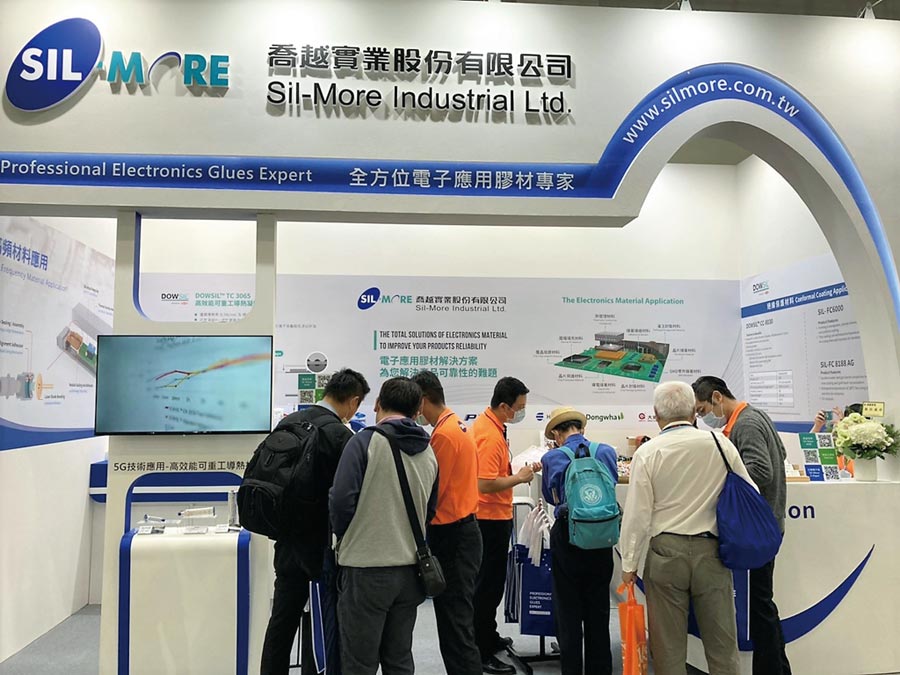
The 2020 Taiwan Circuit Board Industry International Exhibition will take place on October 21, with Sil-More showcasing 5G-related electronic material applications and technologies at this exhibition (Booth #N0018, Nangang Exhibition Center Hall 1, 4th Floor), providing the most synergistic integrated solutions, including "thermal conductivity, electromagnetic wave shielding, circuit board assembly, component bonding and sealing, chip insulation packaging, and module moisture-proof coating."
These thermal management materials are used in the fields of communication and data transmission devices, such as high-frequency optical communication modules, network routers, and handheld devices. They not only meet the thermal interface material requirements for high power 5G but also significantly improve production efficiency and reduce costs.
The emergence of new 5G technologies drives the future development of global technology, establishing the three major characteristics of 5G: "high bandwidth," "low latency," and "multi-connection." Whether in terms of speed, transmission volume, or device coverage, it is evident that the combination of 5G and IoT will transform the existing landscape of various industries. In the face of the trend towards thinner and lighter consumer electronics, the innovative material applications in smart manufacturing present significant challenges.
Sil-More Group represents a series of innovative thermal conductive materials, including Dow Chemical's DOWSIL TC-3065 thermal conductive gel, which is a one-component material that can cure at room temperature. It has a high thermal conductivity of 6.5 W/mk, a high extrusion rate of 60 grams per minute, no oil seepage, and extremely low volatile organic compounds (VOCs) content. In operation, it is applied using an automatic dispensing machine, quickly curing through heating, and after curing, it is not prone to cracking or oil seepage, resistant to moisture and other harsh environments, and does not easily crack under long-term aging conditions, making it easier for electronic components during assembly. During the application process, the gel exhibits a soft form, allowing it to form various thicknesses and shapes, which can replace traditional thermal pads.
At the same time, when filling gaps in modules, it can protect electronic components. If rework is needed, the gel can be easily peeled off without residue, specifically designed for the thermal management needs of high-power 5G electronic components. Additionally, Sil-More also provides a non-silicone thermal filling material solution—AOS thermal material, which has a high thermal conductivity of 7.4 W/mK, along with low thermal resistance, extremely low oil separation rate, and no small molecule siloxanes. In operation, it does not contaminate surrounding components, has a thin viscosity, and high adhesion to interfaces, demonstrating excellent conductivity and reliability in high-frequency, high-power component operations.
Data source:Commercial Times/Written by Huang Zhiwei 2020/10/22

China Kunshan Subsidiary
TEL:+86-512-5778-9977
FAX:+86-512-5778-9944
E-Mail:silmore@silmore.com.cn
Website:http://www.silmore.cn/
Address: 13th Floor, Building 4, Chengbei Lake Commercial Center, 1188 Chengbei Road, Yushan Town, Kunshan City, Jiangsu Province, 215300
China Dongguan Subsidiary
TEL:+86-769-8541-8158
FAX:+86-769-8541-9158
E-Mail:service@silmore.com.cn
Website:http://www.silmore.cn/
Address: No.8 Huafu Road, Shangsha No.6 Industrial Zone, Chang 'an Town, Dongguan City, Guangdong Province, China 523000