
Sil-More Electronic Newsletter - Issue 20 - New Organic Silicon Protective Coating Materials for PCBs
2018/12/06|Subscribe to the newsletter
New organic silicon protective coating materials for PCBs
Invited to participate in Dow Chemical's 50th anniversary
2018 Sil-More Group exhibition review
Annual employee trip for each branch
2019 Sil-More Group exhibition preview
 New organic silicon protective coating materials for PCBs
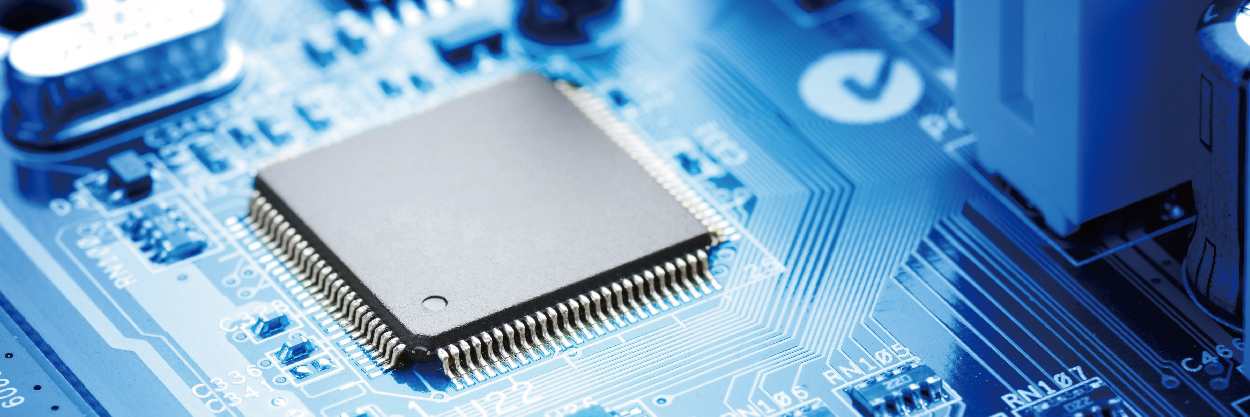
With continuous innovation in technology, the number of components in electronic products is increasing, and the circuits and components on printed circuit boards (PCBs) are becoming more and more dense. To prevent exposure to extremely harsh environments from causingCorrosion of circuitsor to eliminate certain electromagnetic interference, surface treatment (PCB Surface Finished) and protection of circuit boards become even more important.
From the perspective of fine lines on printed circuit boards, coupled with the increasing awareness of environmental protection, Dow Chemical has launched a new productDOWSIL™ CC-3122A solvent-free organic silicon coating protection materialwith low viscosity and low dynamic friction coefficient, can freely flow into fine gaps and narrow spaces on PCBs and components. At the same time, the fast-flowing moisture-curing material supports manual or automatic spraying, which can shorten processing time without the need for oven heating, although gentle heating can significantly accelerate its curing speed. After curing, it has high hardness and low surface stickiness, protecting sensitive components and reducing dust absorption. Another feature of this product is that it can provide long-term reliable protection for printed circuit boards (PCBs) under extreme harsh environmental conditions, and has been tested and verified to meet automotive industry reliability standards, containing aids to prevent sulfur corrosion, suitable for transportation, aerospace, consumer, and industrial application products, such as motors, generators, transformers, electromagnetic valve switches, etc.
Coating materials are easy to operate, a commonly used solution in the industry:
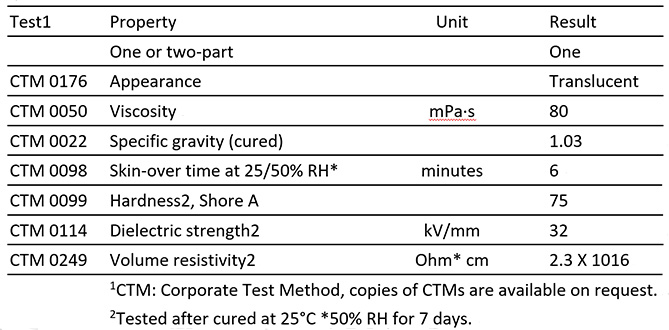
CC-3122 specifications:
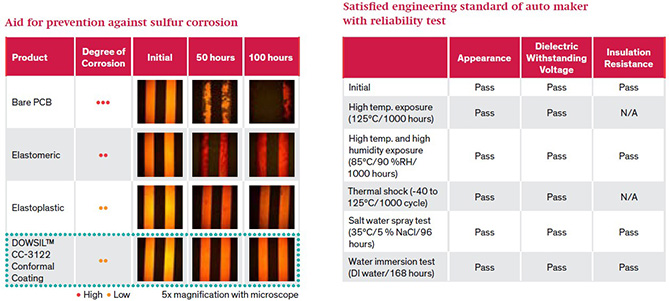
In the face of rapidly changing industrial development, Sil-More Industry frequently shares various new material solutions to meet component assembly performance, enhance product reliability, reduce production costs, and provide the latest professional services, making it your most trusted adhesive material supplier and partner.
※Reference source: Dow Chemical website https://bit.ly/2R0UJrs
──Written by: Business Department Brian Lee
Automotive panoramic sunroof lubrication solutions

Electrical design is just the beginning of electronic products; heat dissipation is an important part that any reliable design must consider. When semiconductors do not achieve 100% efficiency, power consumption is dissipated and transferred in the form of heat. Since semiconductors are components that rely on electrical energy to operate, heat dissipation plays a crucial role in both performance and product lifespan, whether for analog or digital components. Switching power consumption is related to frequency, and as the speed of semiconductors and electronic products increases, power consumption also rises. Therefore, understanding how much heat components will generate and how to dissipate it effectively is beneficial.
To address the issue of general thermal grease degrading over time and forming powder due to the evaporation of silicone oil, Sil-More provides a single-component non-silicone-based high thermal conductive adhesive, Thermal conductive Ink, TCI coating, which has high thermal conductive ink characteristics, improving the shortcomings of inorganic filler sedimentation, and enhancing the long-term reliability of superior interface materials. It is widely used in the thermal coating of electronic components, bonding, or other thermal and assembly applications, especially in high-power electronic component interface applications.
Thermal interface material applications
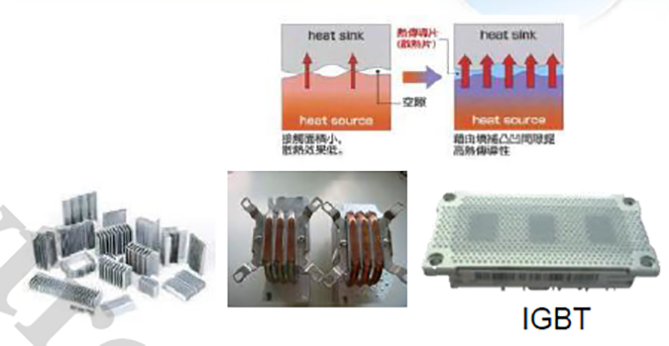
In the heat dissipation path, the contact situation between components and the thermal conductivity of interface bonding materials are closely related. When two components are joined, even if the surface flatness is good or a large mounting pressure is applied, perfect tight contact cannot be achieved. As shown in the figure below, there is only partial contact, and many fine gaps or holes exist in the contact surface. Since the air in the gaps is a medium with relatively poor thermal conductivity, it becomes an obstacle to thermal conductivity. It is necessary to fill a thermal interface material (TIM) between the bonding surfaces to fill the gaps and enhance thermal transfer efficiency to reduce interface thermal resistance.
PCB thermal conductive ink applications
The existing processes and materials of traditional printed circuit boards can no longer cope with the increasing temperatures of processors and chips. The newly developed heat-dissipating printed circuit boards use thermosetting heat-dissipating solder mask ink on the upper and lower surfaces of the circuit board, effectively dissipating heat from the surface. Printed circuit boards using new materials and new processes dissipate heat faster and are more energy-efficient.
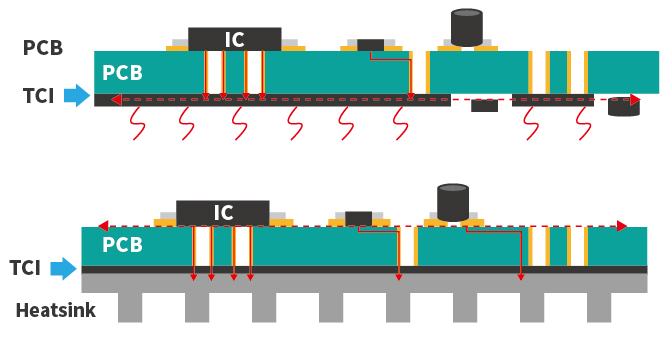
To meet the market demand for PCBs of different product types, TCI products have developed from thermal interface materials to the application of thermal conductive inks, evolving from the role of a heat dissipation medium to a new choice that better fits customers in fanless heat dissipation environments. Facing various products with different heat dissipation mechanism designs, Sil-More Industry will share comprehensive material application solutions with you based on years of practical experience in the field of thermal materials.
※Data source: EDN Taiwan Electronic Technology Design Networkhttps://bit.ly/2S1HG9c
Material World Networkhttps://bit.ly/2zgzgnt
DIGITIMEShttps://bit.ly/2Qiik9E
─Written by: Project Department Porter Chen
High-performance long-fiber thermoplastic composites
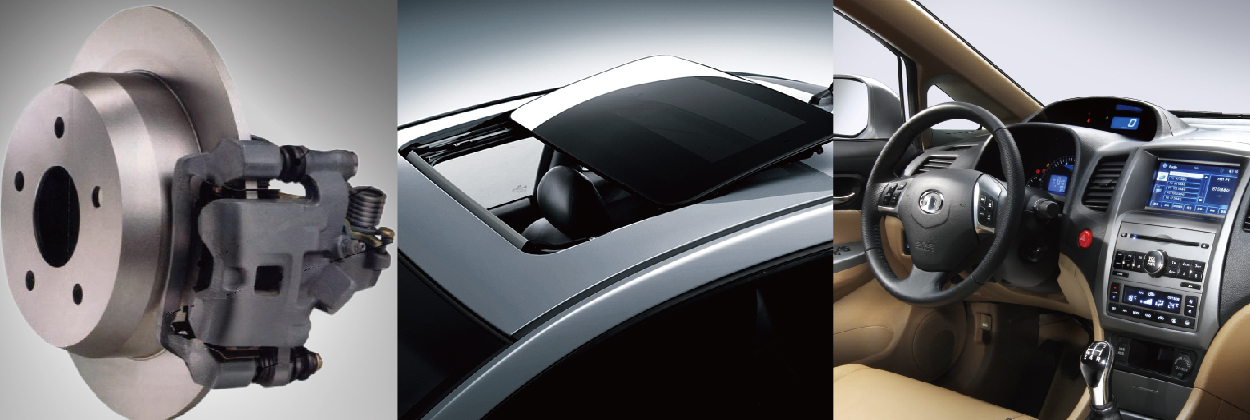
Long-fiber reinforced composites (LFRT) have excellent rigidity, strength, and impact resistance, which can replace metal materials in industrial components, effectively reducing product weight, and the surface of molded products has good gloss and smoothness, with better wear resistance and dimensional stability than general composites.
The basic length of long fiber reinforced composite particles can range from 6mm to 12mm, widely used in electrical appliance housings, automotive components, various machine components, sports equipment, and the information industry, and can also be applied for electromagnetic wave shielding EMI effectiveness.
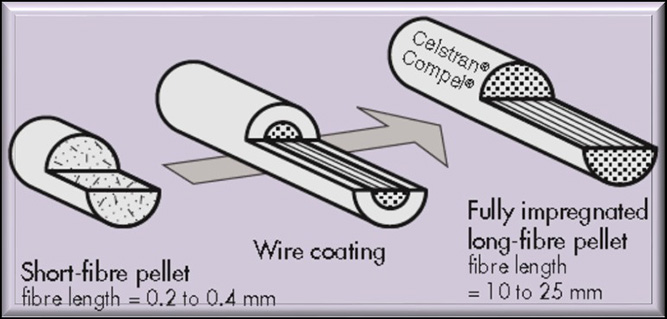
In terms of the development and application of processing technology, LFT has the following advantages:
- The moldability of the processing method is the same as that of short fiber reinforced materials (SFT), but the fibers form a three-dimensional network structure in the thermoplastic resin matrix in a long size, significantly enhancing the mechanical properties of the finished product, especially in terms of impact strength performance.
- The specific strength of general aluminum materials is 9.8%, while the specific strength of LFT reaches 17.2%. Coupled with its low molding shrinkage rate, excellent creep and fatigue resistance, and good dimensional stability, it is particularly beneficial for design and application in the manufacturing of mechanical or automotive parts and structural components.
- LFT offers more design freedom than GMT or CFRT, making it easier to inject complex shapes and mold, while general GMT composites can only be formed through compression molding.
- Recyclable and reusable, it meets more green and environmental protection requirements in the category of high-performance thermoplastic composites.
Product applications:
- Automotive industry: engine compartment supports, seat frames, dashboard frames, battery mounts, inner door panels, foot pedals, mudguards, spare tire racks.
- Electronics and electrical industry: high-precision connectors/components, printer structural parts, 3C product frames, structural components.
- Petrochemical: corrosion-resistant and wear-resistant parts, platform grating, filter equipment components, reactor parts.
- Others: bicycle seat supports, snowboards, sports equipment structural parts and pedals, safety shoe toes, safety helmets.
※Data source: compiled from the original manufacturer.
GO TOP─Written by: Market Development Department, Burgess Chan.
CAS chemical substance registration number.

CAS.The English term for the number is.CAS Registry Number., also referred to as.CAS Number.、CASRN.It is composed of a string of numerical codes, similar to our ID number, serving as a convenient identification method to avoid the trouble of identifying chemical substances due to different names. This string of numbers can often be seen in.SDS(Safety Data Sheet.)It can often be seen.
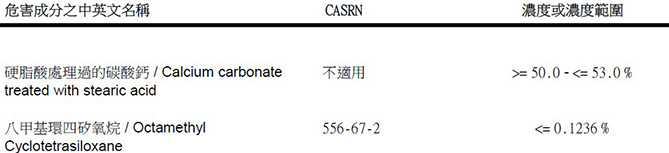
※The above image is sourced from the Dow Chemical product SDS content.
Some customers may ask: "Why are some materials in the SDS without a CAS No.?" The main reason is that the raw materials did not apply for a CAS No., and some cannot be listed due to commercial confidentiality.
The CAS number is organized and published by the.United States.Ohio.Columbus.Chemical Abstracts Service (CAS), a branch of the.American Chemical Society.It is recognized as the most authoritative scientific information organization by many industries, government agencies, and academic institutions worldwide. CAS has a vast database that includes all organic and inorganic substances from the early 19th century to the present, including DNA sequences, alloys, compounds, and many other categories. By mid-2015, the number of CAS numbers exceeded 100 million, and the registration numbers have rapidly increased in recent years, with approximately one chemical substance being registered every 2 minutes and 30 seconds. The current number has reached over 140 million, indicating the rapid development in the field of chemistry.
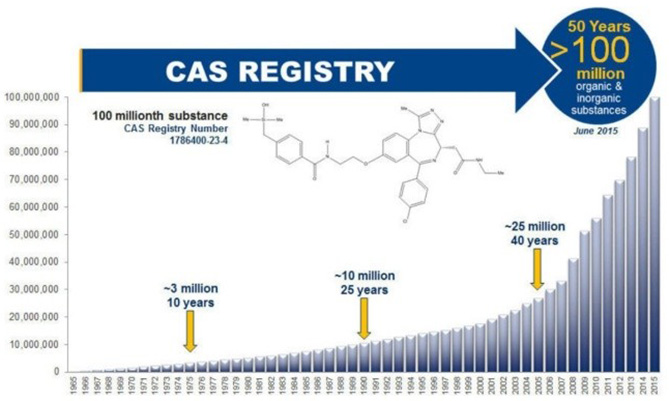
※Data source: Chemical Abstracts Service.
─Written by: Technical Department, Kelvin Wang.
Invited to participate in Dow Chemical's 50th anniversary

Dow Chemical Company (Dow) celebrated its 50th anniversary of operations and growth in Taiwan on October 26, with General Manager Yang of Sil-More Group honored to be invited to the celebration. The dinner that day was attended by over 230 customers, partners, and representatives of the Dow management team.
─Written by: Marketing Department.GO TOP
2018 Sil-More Group exhibition review
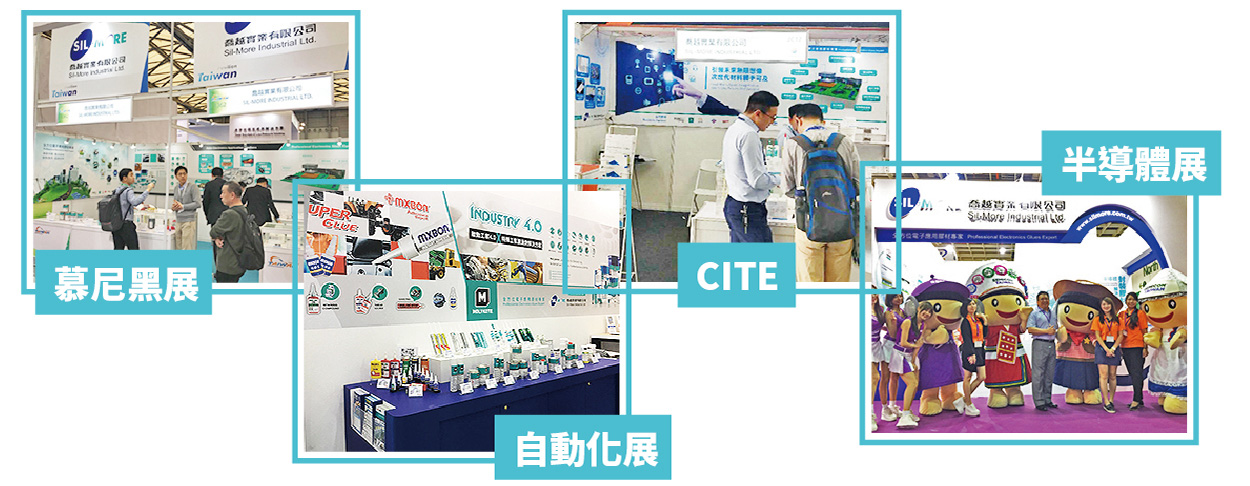
This year, Sil-More Group held professional exhibitions in both Taiwan and mainland China, focusing on the pulse development of various industries, providing on-site professional explanations and consultations.,The exhibition results received high recognition from visitors, and we sincerely thank all customers and partners for their presence and support!
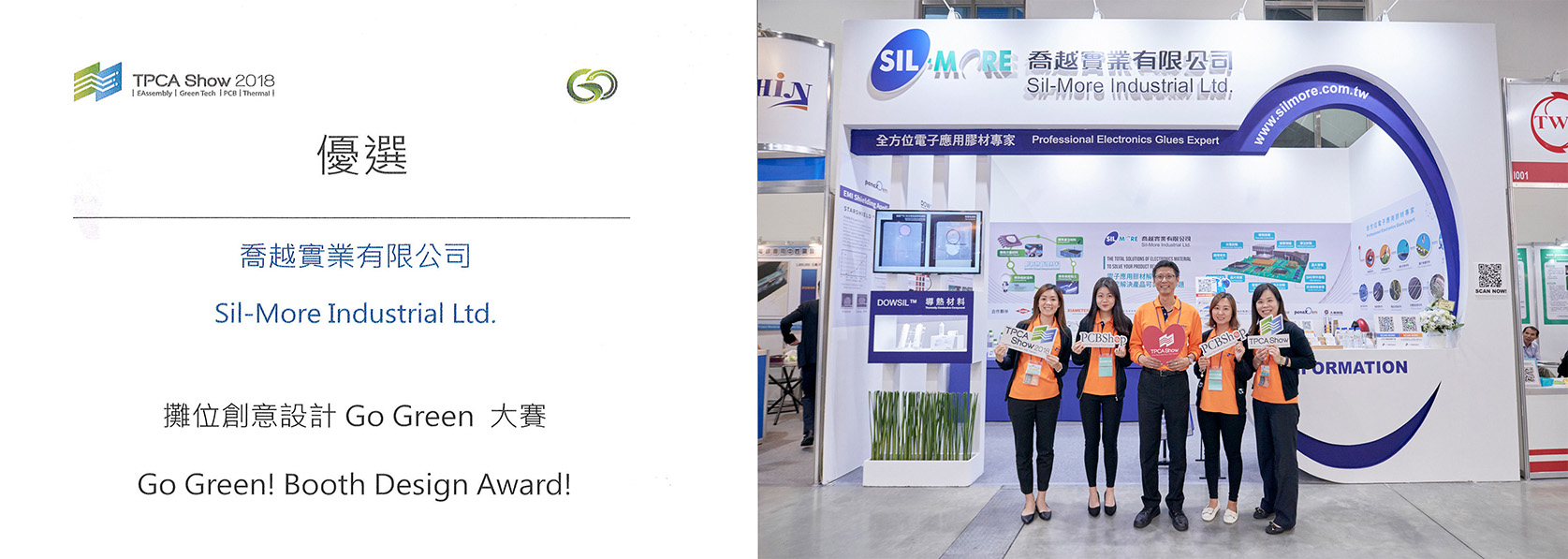
At the same time, this year TPCA awarded the booth creative design GO GREEN competition - excellence, thanks to all colleagues for their efforts in the exhibition results.
─Written by: Marketing Department.
Annual employee trip for each branch

Sil-More Group has always emphasized the balance between work and life. To thank employees for their contributions and efforts over the year, the welfare committee of each branch planned overseas travel, allowing employees to relax amidst their busy work, enhance communication among colleagues, enrich experiences, and broaden their horizons; at the same time, through this travel activity planning, enhance the organizational capabilities among teams.
─Written by: Welfare Committee of each branch.
2019 Sil-More Group Exhibition Preview.
| 03/14-03/17. | Shanghai New International Expo Center SNIEC - Shanghai, China. | China Household Appliances and Consumer Electronics Expo - Appliance & Electronics World Expo - Shanghai 2019. |
| 03/20-03/22. | Shanghai New International Expo Center SNIEC - Shanghai, China. | Munich Shanghai Electronics Production Equipment Exhibition - Productronica China 2019. |
| 04/24-04/27. | Taipei Nangang World Trade Center TWTC Nangang - Taipei, Taiwan. | Taipei International Automotive Electronics Show AutoTronics Taipei 2019 |
| 06/09-06/12 | Canton Fair Complex-Guangzhou, China | Guangzhou International Lighting Exhibition 2019 |
| 08/21-08/24 | Taipei Nangang World Trade Center TWTC Nangang - Taipei, Taiwan. | Taipei Int'l Industrial Automation Exhibition 2019 |
| 08/28-08/30 | Taipei Nangang World Trade Center TWTC Nangang - Taipei, Taiwan. | Touch Taiwan 2019 - Display International |
| 09/18-09/20 | Taipei Nangang World Trade Center TWTC Nangang - Taipei, Taiwan. | SEMICON Taiwan 2019 |
| 10/23-10/25 | Taipei Nangang World Trade Center TWTC Nangang - Taipei, Taiwan. | TPCA Show 2019 |
| 11/28-12/01 | Shanghai New International Expo Center SNIEC - Shanghai, China. | Automechanika Shanghai 2019 |
─Written by: Marketing Department

China Kunshan Subsidiary
TEL:+86-512-5778-9977
FAX:+86-512-5778-9944
E-Mail:silmore@silmore.com.cn
Website:http://www.silmore.cn/
Address: 13th Floor, Building 4, Chengbei Lake Commercial Center, 1188 Chengbei Road, Yushan Town, Kunshan City, Jiangsu Province, 215300
China Dongguan Subsidiary
TEL:+86-769-8541-8158
FAX:+86-769-8541-9158
E-Mail:service@silmore.com.cn
Website:http://www.silmore.cn/
Address: No.8 Huafu Road, Shangsha No.6 Industrial Zone, Chang 'an Town, Dongguan City, Guangdong Province, China 523000